By William Flockton
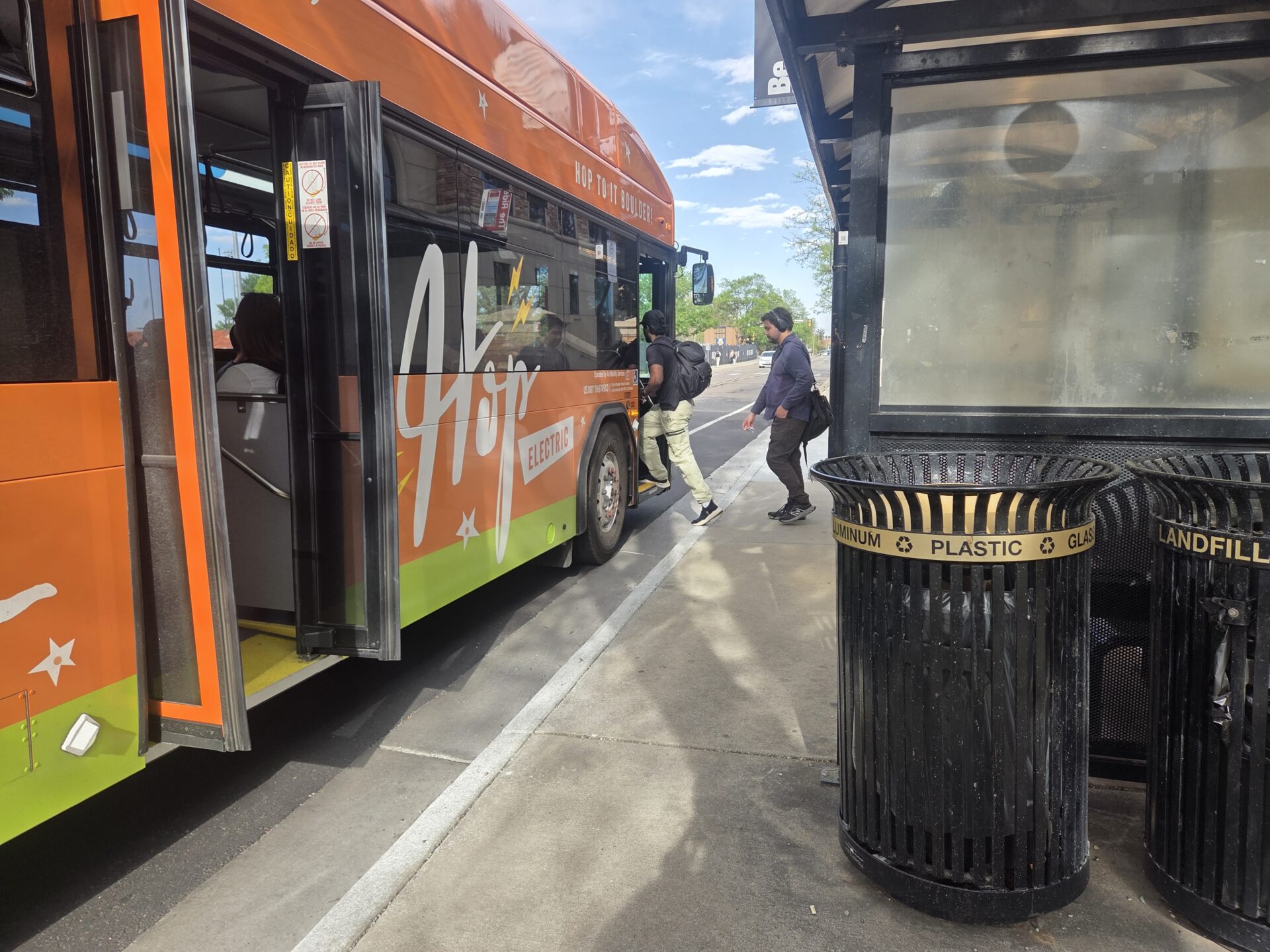
Two transit riders board the HOP bus service, which has multiple stops at the University of Colorado Boulder. University of Colorado Boulder, Boulder, Colo., Tuesday, April 21, 2026. The city of Boulder, the Regional Transportation District and the University of Colorado Boulder come together to fund the HOP bus service. The result is a bus service tailored to the transit needs of Boulder residents and CU Boulder students (Radio 1190/William Flockton)
Air hisses out from the orange bus’s breaks as it pulls away from Colorado Avenue and Folsom Street Eastbound. Seats rattle as the motor rumbles, and the three passengers onboard stare down at the phones in their hand while they wait for the HOP bus service to arrive at their stop.
The HOP serves as just one part of Boulder’s extensive public transit system that is used by Boulder residents and students from the University of Colorado Boulder alike.
Come November, Boulder County will need to make a difficult decision about who manages those buses in the general election, and who will have a seat in planning what transit looks like in Boulder for five years in the future.
This may also include the potential decision to cut local bus routes.
The RTD Board of Directors
“I’d like to call it a hidden gem in a way,” said Audrey DeBarros, the executive director at Commuting Solutions, a non-profit group that advocates to improve public transit in Colorado’s Northwest Metro region. “You know, people, from what I understand, don’t necessarily know the role of the RTD board and that it’s an elected position.”
The Regional Transportation District is a public agency that supplies and manages public transit in several Colorado counties, including Boulder County. The agency is overseen by the RTD Board of Directors, which are 15 public officials who are voted into the position through their county’s general election.
The board creates policies for the agency, approves the agency’s budget and receives public feedback. Board members also hire the agency’s general manager and chief executive officer.
“Each of these directors represents their own area of 215,000 constituents,” said Jack Rosenthal, a software engineer at Hudson River Trading. “It is really prudent that we elected somebody who’s going to represent our community really well when it comes to our public transit needs for that seat.”
Boulder County has been represented by Lynn Guissenger on the board since 2019 as part of RTD District O. However, now that Guissenger has reached the two-term limit, there is an open seat for her district. Two Boulder residents, DeBarros and Rosenthal, are campaigning to be the person who will Guissenger’s seat and represent Boulder County on the board.
“I came into this thinking, it’s the RTD Board of Directors, and historically people have not paid too much attention to these sorts of races,” said Rosenthal. “I very quickly learned that there’s a lot of eyes on RTD right now and that a lot of people want to see change.”
The main issues
DeBarros and Rosenthal both identified RTD’s finances as a key issue that could have a significant impact on Boulder residents.
“RTD has a really tough financial future outlook,” said Rosenthal. “RTD’s cost of operating service, and this is actually nationwide, cost of operating service, just goes up and up every single year, so every single year it costs more and more to operate service.”
The agency’s primary source of revenue comes from 1% of sales and use tax collected in the Denver metro area. These taxes made up for 69% of the agency’s $1.5 billion budget for 2026, according to RTD. The Denver Post reported that RTD estimated their budget deficit to be between $100 million and $400 million dollars in 2025.
Part of the issue RTD faces is maintaining the currently existing public transit it already has.
“RTD has a system that is getting older,” said DeBarros. “It’s 30 years old in some parts of the Denver metro area, and so the cost to maintain the system is getting more and more expensive. Meanwhile, sales tax is a declining revenue source right now.”
The solution is not as simple as raising taxes to increase funding for public transit. Colorado’s Taxpayer’s Bill of Rights limits how much money the state government can collect and retain, and it requires voter approval to create specific tax increases.
“RTD’s service distribution right now is not equitable to the population,” said Rosenthal. “Certain places in RTD get more service for the population than others.”
According to Rosenthal, RTD has focused on using ridership data to determine where public transit routes will see use when planning to create new ones.
“It is a very large district,” said DeBarros. “Because our population is so spread out, it makes it challenging to operate service that is effective when you’re trying to serve all four corners of a 2,300 mile district.”
Ridership data might help to place public transit effectively, but it does not solve the issue of convincing taxpayers of RTD’s worth if there is not a bus or train near them.
In March 2026, RTD announced that its Comprehensive Operational Analysis project will evaluate the agency’s public transit service for areas of improvement, which includes cost-effectiveness. The agency plans to use the analysis’s results to create a five-year service plan that will determine how public transit will change over a five-year time frame beginning in 2028.
“The region is coming together to look at a transit vision for the future, and they’re developing a five-year service plan as a part of that,” said DeBarros. “Concurrently their budget is in a world of hurt right now. There’s going to need to be some real conversations around what they can’t afford.”
While it is unknown what those cuts might be, and how RTD’s finances will look in the future, Rosenthal predicts that budget cuts could hurt Boulder County.
“I think if we don’t figure out a new permanent source of revenue, you know, by 2031-ish, sort of, it would be pretty major service cuts,” said Rosenthal. “I would say almost all local service would probably end up cut and that RTD would look like a more regional network.”
Buses and Boulder
Boulder is home to 10 local bus routes throughout Boulder County, allowing for transportation without having a car.
“There’s a lot of stops in Boulder, and there’s a lot of routes in Boulder,” said Gracie Garcia, a junior at the University of Colorado Boulder. “You can kind of get anywhere you need to on the buses.”
Garcia used to ride the bus three times a day until she was finally able to bring a car with her down to college. The local bus routes allowed Garcia to navigate between work, classes, grocery shopping and her home.
“Uber is really expensive in Boulder, and the bus is free for students,” said Garcia.
The university includes an RTD pass in the tuition of each student enrolled. It even stated that it preferred students to not use cars at all in an alumni newsletter.
“Most students do not have cars,” said Garcia. “All the freshmen especially don’t have cars because they don’t have a place to park it on campus.”
Garcia also feels that RTD buses are a safer choice than apps like Uber or Lyft.
“Coming from the perspective of a young female student, Uber drivers can’t always be trusted,” said Garcia. “But when you’re on public transportation, there’s other people with you, so you’re not alone in a car with somebody who you don’t know; and also the drivers have to be tested by RTD and they are reliable and there’s cameras on the buses so you know that things are regulated and inspected properly.”
Boulder’s RTD system allows not just students, but anyone without a car, to access public transit.
“Cars are expensive,” said Rosenthal. “The costs total up between not only fuel costs and direct costs of driving it, but insurance, registration, depreciation of the vehicle’s value while you own it.”
Public transit has even helped people who don’t use it by reducing traffic for those driving in cars on the road.
Students will also have an important voice in this election. RTD has based frequency over when CU Boulder students are in the country, according to DeBarros.
“Student voices matter because students are a main audience in the city of Boulder for how they want to get around locally and regionally,” said DeBarros.