
By Nano Watson
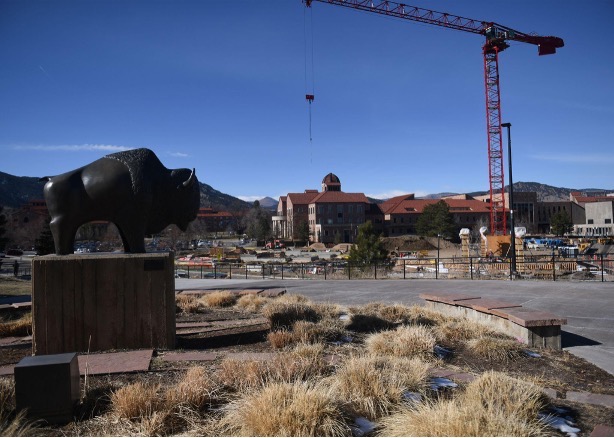
On Friday, Jan. 30, the University of Colorado Boulder’s campus continues to hold construction sites visible to students and visitors. This is the biggest site on campus, just outside the CU events center. (Nano Watson/Radio 1190)
For much of his time studying at CU Boulder, Henry Miller had been troubled by construction. There are days the junior integrated physiology major feels like his entire college experience is surrounded by fencing and disrupted campus spaces, which he finds maddening.
“I’ve noticed that things just take a really long time to be built,” Miller said on a sunny January afternoon around the fencing on the library quad. “And it really is just infuriating because I think they’ve been doing the same exact builds for two plus years. And it feels like nothing’s getting done.”
Miller is not alone. CU’s campus has been engulfed in construction projects, forcing students, faculty, and staff to avoid areas with heavy-duty equipment, altering walking routes, and cramming learning spaces. Though campus officials say the mix of renovations and new structures is needed to accommodate a growing campus community, the work is also causing a lot of inconvenience.
It began five years ago with the renovation of CU’s Old Main, 50 years after the last renovation of the 150-year old building and has expanded into multiple campus projects. This includes the Hellems Hall and Ekeley renovations and the $175 million project for a new Chemistry and Mathematics building. But the problem doesn’t seem to be the idea of campus expansion.
The prolonged construction has reshaped how many students move through campus, turning a once-reliable academic space into temporary waypoints. Classes are frequently relocated, study spots disappear behind fencing, and students often find themselves crisscrossing campus to keep up with shifting schedules and room assignments.
The CU campus has begun to feel disjointed, without a community where learning can settle.
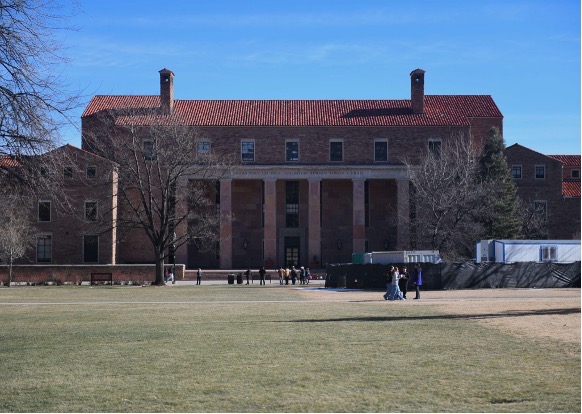
These pop up construction sites like this one outside the library have become the norm. Christian Students Association hands out Bibles and plays songs on Friday, Jan. 30, avoiding fencing. (Nano Watson/Radio 1190)
“I feel like I’ve seen no fruits of the construction at all. I don’t see what the point of that was. There was a point where the philosophy department was homeless,” Michael Ingram, Philosophy student, said.
CU’s once beautiful campus, which brings eyes from all over the world, has now been degraded by modern machines, digging up the earth and blocking walkways. Sophomore Jake Kubiak said, “I think there are definitely some issues with the construction on campus when it comes to visibility.”
However, even with many students on campus concerned about the projects, there is an underlying issue with the population growth of the college and the surrounding area. In the fall of 2025, enrollment numbers broke records, blowing past 40,000 compared to the pre-COVID totals of 34,000.
Morgan Straw, a freshman at CU, sees the construction as necessary for future incoming students. With construction possibly promising relief for future classes, CU doesn’t have much choice but to expand, even as the burden of that growth is felt most sharply by current students.
“Coming into Boulder as a freshman, people are having issues with dorms. Some people had to live in hotels at the beginning of the year. So I think this construction is not only needed, but should be, you know, forced,” Straw said.
Boulder has increased its population nearly 600% in just 70 years, partly driven by CU, federal research labs and a thriving high-tech and biotech industry. Once a small town, Boulder has now transformed into a premier hub for innovation.
As Boulder’s transformation accelerates, the university sits at the center of that growth, both fueling the city’s expansion and absorbing its consequences. The chaos that students experience on campus isn’t an independent problem but a sign of a much larger shift. A shift that reflects decades of steady growth and little acknowledgment of continued demand. For most students, the question is no longer whether expansion should happen, but who bears the cost while it unfolds.
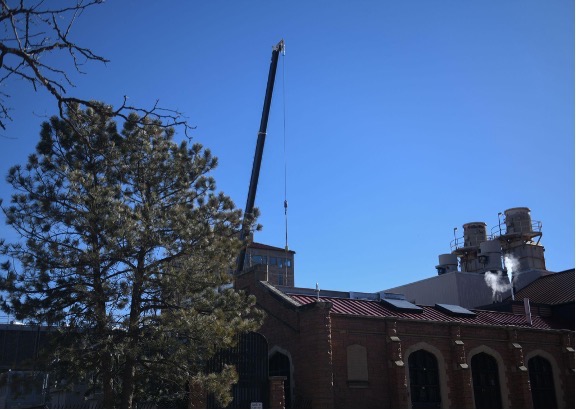
A crane loads heavy metal onto the West District Energy Plant on Friday, Jan. 30. (Nano Watson/Radio 1190)
“I think it’s necessary. I mean, it needs to be expanded, and things need to be done. I guess, some people are going to have to suffer sometimes for the greater good, you know, if we’re looking at a utilitarian type thing,” said Jules Herrick, as she watched a crane move metal framing for the campus energy plant.
It’s become apparent that CU is growing by the year, and the expansion of college grounds is needed. This means adapting to campus influx, walking past new work zones that change each semester. While Henry Miller and Michael Ingram may remember their college years framed by scaffolding, future students may not face the same disruptions.