
by Gavin Orth
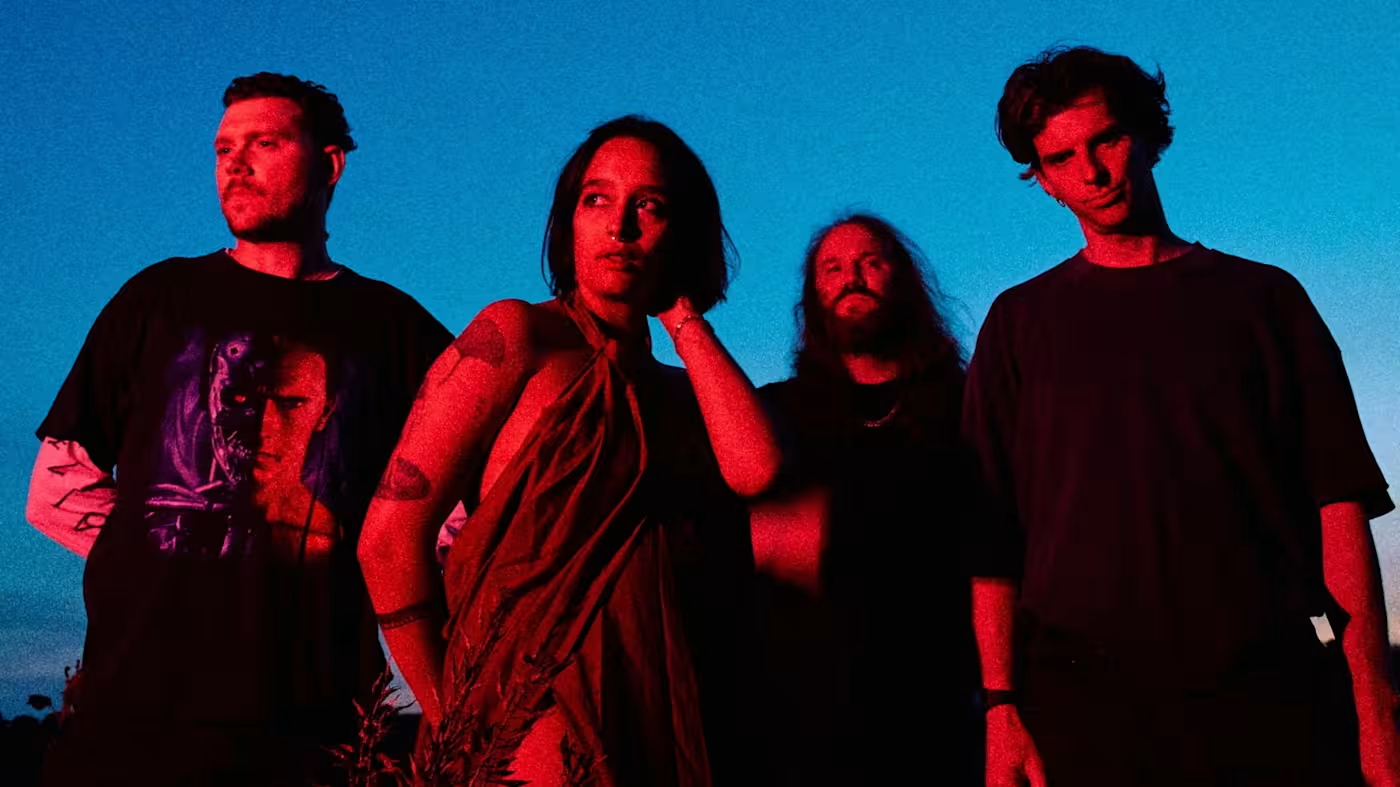
This February, Manchester-based band Mandy, Indiana released their second studio album, URGH. It’s noisy, aggressive, at times incredibly abrasive; it’s also incredibly danceable. The album is meticulously produced to constantly catch its listener off guard, with a miscellany of electronic tricks that obfuscate the fact that Mandy, Indiana is, in fact, a band. Their members are vocalist Valentine Caulfield, who performs in her native French, guitarist and producer Scott Fair, drummer Alex Macdougall, and synthesizer player Simon Catling.
We spoke with Scott about the band’s non-musical influences, their newfound accessibility, his first time seeing Eraserhead, and the possibility of a Mandy, Indiana video game.
How did Mandy, Indiana form?
It was quite simple, really. Valentine is from Paris, originally, but she lived in the UK for a long time – in Manchester. That’s where she and I met, at a show. She was performing with her band and I was performing with my old band, and they did one song where she sang in French – the rest of the time she sang in English – and I said to her afterwards, “That was really powerful when you sang in your native language. I found that really interesting.” And she was like, “Oh, cool.”
We just kept in touch and decided to do something together, and formed the band around that idea of playing to audiences in Manchester, but her singing in French, shrouding what she was saying in a bit more mystery. It all happened pretty organically. From my perspective, I saw her playing and thought she was a really great, arresting performer, really interesting, unique kind of voice. So I was really keen to work with her. And the rest is history.
Something that immediately grabs your attention when listening to Mandy, IL is not immediately understanding what’s going on sonically.
Yeah, we’re keen for things to be overwhelming in that way, because I think a lot of music we were hearing at that time, and maybe are still hearing now, isn’t challenging enough. It’s not doing enough to force somebody into active listening. I think the Spotify generation has this effect on people of always listening to music, and it always being this passive thing. I think there’s still plenty of people out there who seek out interesting music and want to engage with it in an active way.
We make a deliberate effort, even with the cover of [URGH], to have some kind of interactive element so that you can engage with it in some way. You’re not just seeing it in a playlist, it’s like ‘Oh, there’s actually another deeper level to this, there’s more to see here.’ That’s a reflection of the music as well. There’s more to hear if you put headphones on and turn the volume up and spend time with it.
What are you doing, when approaching production, to force someone to actively engage with the music?
I’m a fan of things that are complex from a production standpoint, not necessarily from a compositional standpoint. A lot of artists like Oneontrix Point Never or Spirit of The Beehive are a huge influence; they can continually alter textures or change the rhythm of the track unexpectedly. It’s all done in this very unceremonious way, which feels like it pays no respect to traditional songwriting. That’s often where I come at it from a production standpoint: with a band like ours, the production and songwriting are all kind of one thing. Our approach is a bit more like an electronic artist in that sense: even though we’re a guitar band, it all gets pieced around. We borrow a lot from those artists that are throwing everything at the wall, and having everything stick. How many interesting ideas can we pack into a song, and it doesn’t matter if it’s a song in a recognizable sense.
A lot of the reactions that I’ve seen from people who are new to our music are like, “It’s so messy, I don’t understand it, I don’t get what they’re going for, it sounds unfinished.” I think if you spend time with it, it’s actually pretty conventional. We call ourselves experimental, but that’s just because we want to stay curious. It’s actually pretty easy to dance to a lot of the time.
It’s hard to wrap my head around how the music I hear on the record translates to live performance. How do you keep it at that level of experimentation?
I’m always a fan of when things take on a bit of a new life when it comes to live performance. For a band that has so many electronic elements and dance music elements, we’re actually into playing quite loose wherever possible. We’re not a tight to the grid band when it comes to live; Alex, our drummer, in particular, is keen to never have it sound metronomic. Although what you hear on record sometimes sounds like an electronic artist, it is a band at the end of the day. Part of it is just figuring out ways to recreate stuff live. There’s a lot of crossover of elements on the album — you’re not sure if you’re hearing a synth or a guitar, it could be one or the other – and when you see it live, you’re just like, “Oh, they made that sound with a guitar. I thought that was a synth kind of thing.”
What’s your guitar effects setup look like?
Nothing really out there, to be honest. Reverbs and delays; I have a couple fuzz pedals that have feedback looping on them, which I use quite a lot. I had a noise pedal custom made by this guy in Bristol — he made this thing that had a momentary switch that meant I could do rhythmic bursts of noise, because there’s a lot of that in the production I do as well. I use noise often, and before I had this pedal made, I didn’t have anything to do that live.
Alan from Gilla Band is a big pioneer: I don’t know if he came up with it, but the whole switching things up in the pedal chain so you’re going reverb into fuzz. I use that technique a lot to blow out the sound, so it becomes more of a wall of noise and there’s less definition in notes.
There’s a lot of room in music for combining pure noise with a rhythmic base. How do you pull off using this combination effectively?
Techno is another genre that we’re massively influenced by. There’s a lot of subgenres in that world that are built just around those two things – just noise and rhythm, you know? An artist like Blawan who’s pushing things to extremes and getting really crazy controlled noise, so it feels like there’s something tonal about it, but there’s no melody in there. It’s just another rhythmic element. We listen to a lot of soundtracks as well, where it’s just a pulse and an atmosphere. A lot of our music is inspired by visual media, things we watch or games that we play. It’s like, how do we recreate that in a satisfying song that’s good to listen to detached from any kind of visual element.
I definitely feel strong influence from late-style David Lynch in the music and broader aesthetics of the album. The horrible digital vibe of Inland Empire, the sound design in Twin Peaks: The Return.
You couldn’t hit the nail on the head much closer. It’s no secret that he’s been a big influence on us; one of the tracks on the new album even references a line from Eraserhead. You mentioned The Return as well – I think it was Episode 8, with the bomb, and all the video art – to see something like that on broadcast television is absolutely wild. How could you not be inspired by a creative like him?
Alex and I went to see Eraserhead at this cinema in Manchester last year, and had this surreal experience because it was in the middle of the summer, it’s a little, cool theater, sixty or seventy seats, and they didn’t have any air conditioning and it was the hottest day of the year, so it was like a sauna in there. We were also late to the screening, so we didn’t get to sit next to each other. We came out dripping with sweat and were like, “Wow, that’s the way that film should be seen. In severe discomfort.” It felt more transcendental in some way. Everything was that much more visceral because we were sweating buckets and we burst into the cinema. Cortisol spiking.
The first time I saw Eraserhead, I was in this basement with exposed pipes and insulation, and there was a cat running around in the dark. Every so often, I’d just feel something rubbing up against my leg.
It’s weird! Sometimes the planets align and something happens, and you feel like, “This was the way I was supposed to experience this thing.” What you describe sounds very much like that. You’re being taken out of your comfort zone because you’re not in what you would recognize as a normal space. There’s something there that really enhances the experience.
What sort of space did you create the album in? Was there attention to this sort of environmental feeling?
Because of the way this stuff is put together, a lot of it is just: bedroom, on a computer. We weren’t necessarily seeing each other all that often while it was being written. Valentin doesn’t live near us anymore. Even the other three band members weren’t rehearsing or seeing each other loads. We had this little writing session in this house in Leeds, which was really interesting; we were really productive there, got a bunch of stuff done. But a lot of the rest of the time we were all so busy with our day jobs, fitting it in where we could. The way we did it, some people might think it would be stifling for creativity, but it’s amazing, if you really care about your craft, how much you’re willing to go “Oh, man, I got zero energy to do this right now, but I got you.” And we were all so happy with the results.
I think we could probably make an album under any sort of conditions, because this was far from ideal. I mean, several members of the band were hospitalized, having multiple rounds of surgery during the making of it; Valentin lost the vision almost entirely in one of her eyes, Alex was having multiple strain related injuries, and then he had half his thyroid removed as well. It was pretty grueling for us personally.
The first album, there was a lot more playing around with stuff, recording in weird spaces, jamming stuff together. This one felt like we had to be efficient with it, because of everything else that was going on in people’s lives. I recorded my guitar parts literally in the room below where I am now. It’s pieced together from all over the place.
You still have to live your life while making music.
Yeah! As far as I can tell from other bands that we’ve gotten to know, it seems you just carry on. I always thought when you get to this level, that’s your career— now I know that isn’t true. It’s very much still a passion project for us. It’s hard to make money from it, and when your time is so divided, it’s hard to justify it if it isn’t making money. It’s weird, but it’s great. We’re so grateful that we’ve been lucky enough to have really great support around us. We’re certainly not taking any of that for granted.
I’m glad the music has reached the US. It’s nice that there’s an aether of music a casual listener can find something like Mandy, Indiana in.
It’s great. I think you do need to have people who know how to make this stuff happen, to generate hype and exposure. You know, this record is much more accessible than the first one; the first one was a bit more exploratory, a bit more heady. It wasn’t as song based. But even so, that one made waves, and put a lot of people onto it. This one seems to be turning a lot more heads as perhaps an easier entry point to us. Sky’s the limit on a project like this. There’s no way the next album will sound anything like the first two; it’s just going to keep changing and evolving.
The Billy Woods feature on URGH definitely turned heads. Is there a future with more features and collaborations?
I would definitely be up for it. That was such an amazing, dream come true occurrence. I wouldn’t like that to be the identity of the band necessarily, because I think if you collaborate with lots and lots of artists, that draws attention away from the rest of it. But certainly, we see the creative value in collaborating with other artists. Particularly someone like him, because we literally couldn’t have chosen anyone better. What he brings is such gravitas. And in underground terms, he’s an icon! He’s a big deal for a good reason, because he’s one of the best doing it.
Hell, in the future, we’d love to do stuff in other mediums as well. It’d be great to collaborate with a filmmaker; it’d be great to make a short game. We were in a FIFA game, and our track got a lot of attention on the back of that.
Those games put a lot of people onto good music. They tend to have better soundtracks than you would think.
For some people, that might be a primary way they discover music. They might not be Music Fans like you and I, in capital letters; maybe they’re more into gaming. You just hear the music again and again. We got a lot of hate from some of the FIFA fans about our track, though, because there was nothing else on the soundtrack that was like that. I think some people find their music pretty annoying: it’s this angry French woman shouting at you, and it’s just like, “Oh man, this is killing my vibe.” But I was into it. We love all the hate. We love all the backlash. It’s just good that people care enough to want to say something bad about you.
Maybe the Untitled Mandy, Indiana Game is a sports game.
You know what, that’s actually pretty interesting. I wouldn’t have gone there necessarily, but maybe some kind of post-apocalyptic sports game would be rad. It’s not a narrative thing. It’s game-based. Beach-in-Hell Volleyball. We’re onto something here.