
By William Flockton
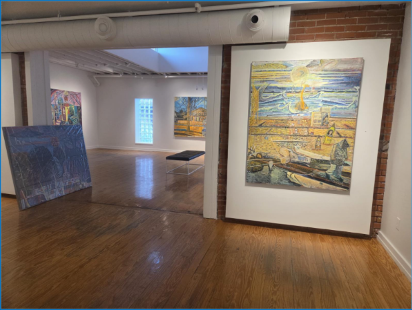
Lydia Farrell’s exhibition, “Strangeday Almanac,” sits at the entrance of The Nick Ryan Gallery at University Hill, Boulder. (William Flockton/Radio 1190)
A flying saucer hovers behind a house in Saint Elmo, Colorado, as skeletal shapes are pulled up into its tractor beam. Down by the beach, a hooded figure walks away from the bodies in the sand and the skeletal plesiosaur. This is the world that non-binary Colorado artist Lydia Farrell brings to life with paint.
These paintings now haunt the Nick Ryan Gallery on University Hill for Farrell’s art exhibition named Strangeday Almanac. The exhibition first opened on Jan. 17, but visitors will be able to explore Farrell’s work until Feb. 28 when the exhibition is scheduled to end.
“There’s tension with things in the paintings that can be disturbing, can be bothersome, can be confusing with things that are just outright laughable,” said Nick Ryan, the art gallery’s owner and curator. “There’s little details and figures hidden in windows and peaking around corners and behind trees, and things that just bring out storybooks from your childhood.”
Farrell’s paintings take familiar, ordinary settings like the suburbs, the beach and the park, populating them with urban legends, little demons and unexpected phrases. Most paintings are based on real-life places, with Farrell’s artistic process often starting with reference photos.
In fact, the paintings’ relationship with real-life places inspired the exhibition’s name.
“I wanted something to address like this sort of like surreal, like phantasmagoric element of these paintings where I’m taking photos from everyday life and everyday settings and adding either what I want to see in them or things that relate to a story or a saying that I’d heard,” Farrell said.
Their style is focused on the idea that anything can have a larger story behind it, from a broken-down truck to a weird washing machine in a junk yard. Farrell began to hone this approach after graduating from college, shifting from landscape painting to focusing on smaller subjects. Nevertheless, the exhibition of Farrell’s work begins with two landscape paintings that hang beside the gallery’s entrance.
“I realize people are gonna get, you know, confronted with this intense imagery,” said Ryan. “And its sort of nice to give the illusion of just a sweet painting show and then, see the work transform as you go along and check out the exhibition. So, they almost get stranger and stranger the farther back you go into there.”
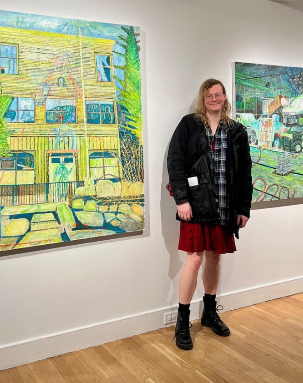
Farrell stands beside their work at the Boulder Museum of Contemporary Art’s “Yes & . . .” exhibit. Farrell and other artists each contributed two works focused on continuity and contrast. The exhibit opened on Jan. 29 and closed on May 3. (Photo courtesy of Lydia Farrell)
Strangness is not the only thing that can be found in these paintings, as their rich imagery weaves together to tell a personal story about Ferrall’s life.
Farrell’s painting “Witchery” is a self-portrait that features the artist dressed as a witch sat beside their own nervous system on a bright pink couch. Ryan explains that it’s a reference to the 1989 Beetlejuice cartoon where the character Beetlejuice’s spirit would walk away, leaving his nervous system behind.
Farrell related the image to how it feels being transgender, and the out-of-body duality that comes with their experience as being non-binary, according to Ryan.
The theme of being transgender reoccurs throughout Farrell’s work and helps to define their art style.
“Being trans has made me think of things that are outside the idea of what you’d call generic beauty, you know, what we expect something beautiful to look like,” said Farrell.
The concept of two-spirit, the Native American term for non-binary people, comes to mind for Farrell. Things can have two spirits inherent in them, which are translated throughout the paintings as uglier figures and topics depicted in bright, beautiful colors.
Substance abuse and recovery are other themes which occur throughout the paintings.
Two of the four books seen on the coffee table in the painting “Witchery” are titled “Addiction is a Disease, not a Moral Failing” and “Recovery Without Dogma or Superstition.”
Farrell began their recovery from alcohol abuse in 2019 by attending Alcoholics Anonymous and going through the Twelve Step program. But over time Farrell found themselves wanting a different community environment than that of AA.
“I spent time in rooms and a lot of people seemed kind of close-minded and very dogmatic and very driven by faith and religion,” Farrell said. “I think, if that works for you and that keeps you sober, it’s good for you. But for me, I kind of wanted a different community and a different approach.”
What worked for Farrell is what the artist describes as a Satanic, non-theistic approach to recovery. Though it is not the Anton Levay concept of Satanism as the organization isn’t centered on the worship of Satan or any god for that matter.
“This is more about resting in your power and feeling more empowered in your sobriety, you know,” said Farrell. “And that doesn’t mean that you lose like your gratitude that you’re alive and that you’re sober, you know, but it looks more like giving yourself a little bit of credit that you’re sober.”
Satanism and sobriety intertwine in Farrell’s painting “The Grimoire.” The piece depicts the artist with horns and wings at the center of a ritual scene burning a blue t-shirt before a grimoire on an altar. According to Ryan, the painting represents Farrell burning the clothes they wore as an addict as a step toward recovery from substance abuse.
The scene features various demonic characters, including a goat-like demon that plays the cello, a wrinkle-faced demon crawling out of a mirror and a black dog with red eyes. Demons such as this in Farrell’s work symbolize protectors, guardians and freedom, according to the artist.
The demons in Farrell’s art aren’t always easy to find like in “The Grimoire.” Clouds shaped like a demon head hide in the right corner of “The Gloaming” and a goat-headed demon with a guitar is wedged at the top of the stairs in“Cthulhu’s Oubliette.” These demons are just one of several small easter eggs inside Farrell’s paintings.
“You see things at different distances too,” said Chris Bristow, a Colorado artist and friend of Farrell.
When the exhibition first opened, Bristow observed that Farrell’s painting “Double House” looked flat up-close. However, from across the exhibition, Bristow experienced a greater depth of field in the piece.
“I’m sort of like invited into the painting,” said Bristow. “It’s really inviting and asking me to explore and it’s also so engaging that I want to.”
There isn’t just one aspect of Farrell’s art that attracts Ryan and Bristow. What invites them into Farrell’s art is the peculiar figures and details, how the mundane is used to tell an odder story, the changes in depth, the intense color, and the balance of humor and horror that Farrell’s art embodies.
“I mean, I, you know, get a visceral reaction when I see the work,” said Ryan. “You know, I love art that gives me goosebumps, and these do.”