
Guillermo del Toro’s Creature Watches a New Sun Rise
By Payton Cordova

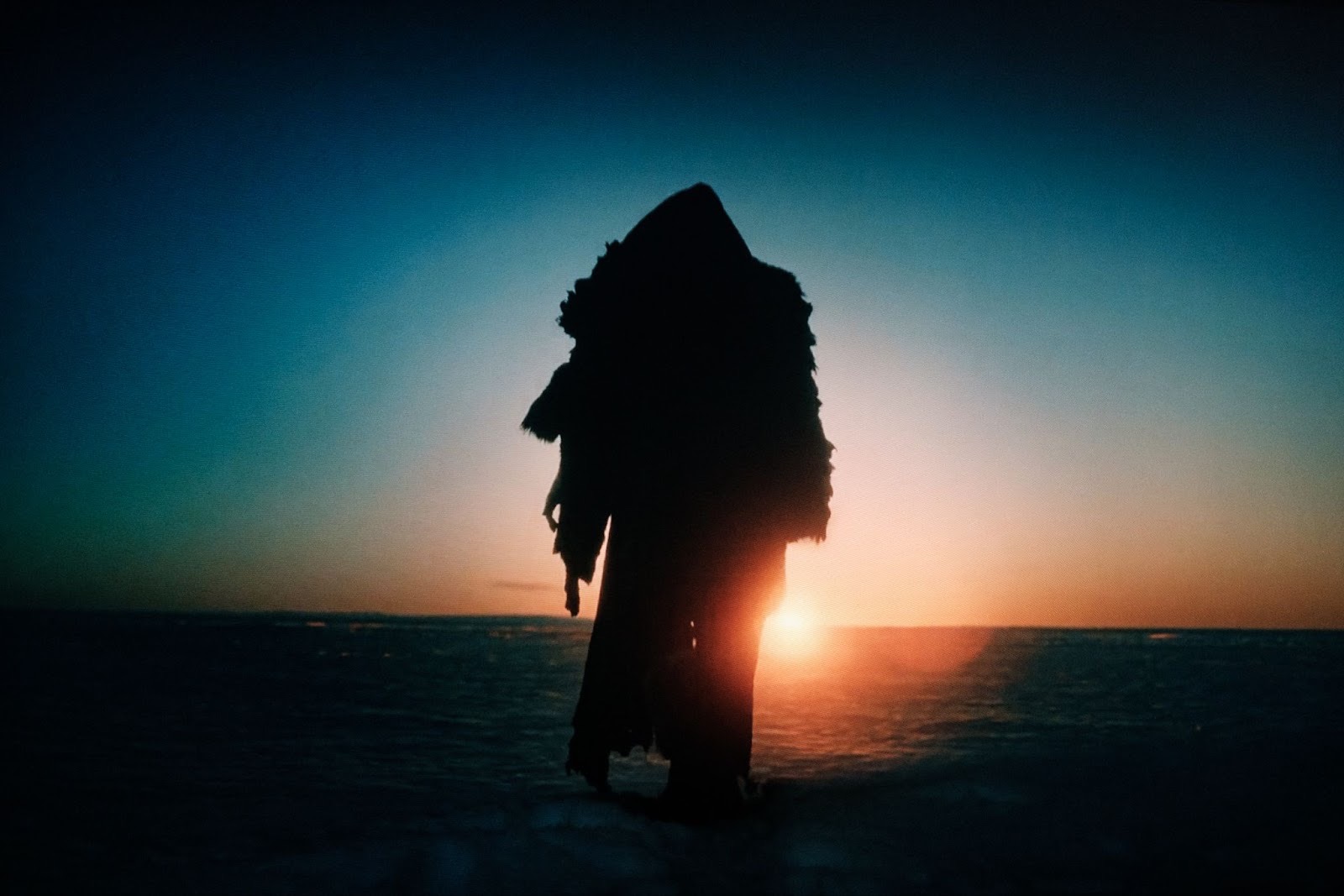
Jacob Elordi stars as The Creature in Guillermo del Toro’s 2025 adaptation of Frankenstein. (Courtesy: Netflix)
There stands a monster. It knows no language, and it cowers in the unfiltered light of the sun.
Its creator says the sun is life, and upon seeing his sublime dream of life from death made manifest, he lowers his head to the monster’s chest. The monster folds its arms around the man; a first act of self-creation, an embrace of love, formed before he would ever know such a word, far before he could know hatred.
Guillermo del Toro’s operatic adaptation of Frankenstein marries Wollstonecraft-Shelley’s tale of monstrous imbalance with that of the prodigal son. A lifetime of conversation with Catholic theology colors the film. Oscar Isaac portrays a ruthless, obsessive Victor Frankenstein slowly consumed by his craft. He is introduced to the audience as a child of nobility, emotionally malformed by the death of his mother and abuse by his father. The film traces his life as he ceaselessly runs from himself, only ever stopping to consider ‘why’ as his breath grows short and time weak. Fathers and sons, pain and ambition–these are the themes through which del Toro’s Frankenstein makes its home.
For all the grand scale of the film’s marketing, the story of Victor and the creature’s pursuit for one another is focused in a tight geography. The 1818 edition of the novel traverses Italy, Switzerland, Germany, Holland, England, Scotland, Ireland, France and Russia all before settling in the arctic. Del Toro instead draws his rendition through Scotland, England, and a few unspecified European estates while keeping the original’s Arctic framing. This transforms the original novel’s epic palette into a fairytale-sharp image of its most elemental characters.
The creature – portrayed by Jacob Elordi – is both Victor’s inverse and mirror, torn between his childlike innocence and the cruelty of man that perennially surrounds him. When his creator violently rejects him, he finds humanity in kind, curious Elizabeth, portrayed by Mia Goth. Elizabeth is Victor’s opposite, set with infallible belief in the good of Nature’s creation. But while Victor’s cruelty and Elizabeth’s kindness both shape the creature, he doesn’t become fully formed until he meets a blind patriarch, who teaches him man’s history and its dream to solve its imperfect conduct. While Victor decries his creation as a “monster,” and Elizabeth idealizes him as a sinless being, the old man simply accepts his strange “friend” as he is. Perhaps his own failings in life allow him the ability to share unqualified kindness now, suggests the script of now sixty-one year old del Toro. The brief time the two share sees Elordi’s character transform from a mute, confused infant into what his creator refused to see him as: a man.
Elordi’s creature may dream of the full drama of human virtue and vice, but his connection to it is only woven through these would-be caregivers: the blind patriarch, Victor, and Elizabeth–and not Wollstonecraft Shelley’s European cities born of colonial riches. Elordi’s unclouded eyes and elemental grace do not encounter any of the displeased violence of man, marked by the shrieks of fear by children or the calls for his death by village and city-dwellers. Victor’s creation–animated from the refuse of urban criminals and foot soldiers in the Crimean war is transcendently human. Elordi is not the dæmon of Shelley’s novel, nor is he Boris Karloff’s green lumbering toddler. Del Toro’s creature has lost the intensity of his self-hatred for his “ghastly and distorted shape” by gaining beauty.
Mary Wollstonecraft Shelley’s revised edition of Frankenstein published in 1831 constantly evokes a controlling fate alien to the 1818 version. In the 1831 text, Victor is compelled to make the creature–hands animated by forces larger than himself, the tragedy he encounters serving as a lesson for readers who consider meddling with the order of death within nature. If there is an air of fatalism in del Toro’s Frankenstein it is the expectation that violence must always reproduce.
It’s hard to leave a viewing of del Toro’s Frankenstein and not be disappointed in the depth given to Victor’s internal life if you are well acquainted with his shading in the novel. Isaac’s character is largely two-dimensional, moving on axes of hubris and jealousy. In designing the creature, he sees his work as dirt that must be sifted through in the pursuit of a pure knowledge–which could be man’s own invention. He jolts through scenes as a set of clothes suspended over a wireframe of blinding ambition–ambition that he could reverse death, at once rebuking his learned father’s legacy and atoning for his mother’s death. Yet beyond the film’s elegant prologue, the sources of his mercurial impulses are hardly explored. His moment of redemption comes suddenly after a life of ignorant cruelty, leaving the viewer without a deep sense of what so commanded him to see the truth of his actions.
Del Toro directs the audience toward expectation of a violent end for both the creature and Victor. Victor himself expects this, he says as much, but at his end he experiences an absolute forgiveness by the tender–bloodied hands of his creation. The father has created a son he did not want. Forsaken and returned, the son now gifts his creator what he couldn’t see as he fled through life. Del Toro’s passion has lived with the creature for so long, that with the film’s conclusion, for him to only be “lost” by the “darkness and distance” of the novel, would be a total rejection of the creature’s capacity for good. Elordi’s creature, tears glancing down his pained face, walks away from his dead creator into the light of an unfiltered sun.
A young Mexican kid raised on EC comics, telenovelas, and the dogma of Catholicism, del Toro found his Jesus in the face of a man-born creature that humanity rejected. His rendition of that story could only end in forgiveness. Why should anyone sing a song if they don’t use their own voice to do it?
The computer generated artifice of del Toro’s deer and wolves will remain. Time does not suddenly impart film grain or scratchy audio to retellings which tend to the hearth of their forbearers. But when critics’ opinions have all been heard, and time has rolled on, del Toro’s Frankenstein will be remembered as a dream for the children who sneak peeks of the monster–and question why he cries at the rising sun, from beyond their parents’ supervision. If taken for the parable it is, it could ignite a generation’s imaginations just as James Whale and Mary Wollstonecraft Shelley’s tales did for young del Toro.