
By Gavin Orth
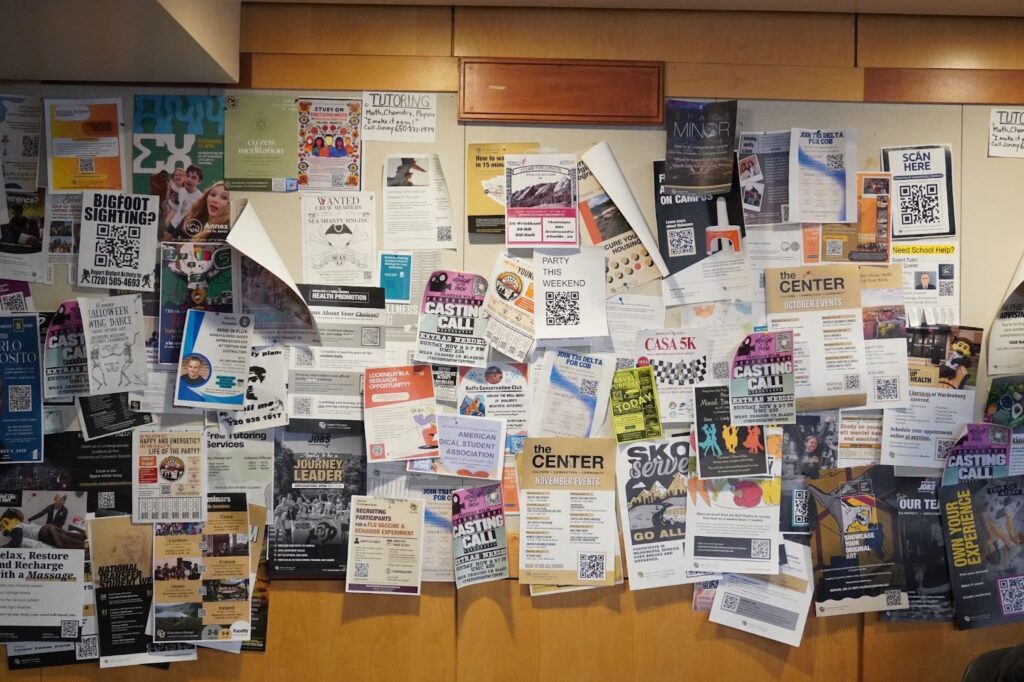
The bulletin board directly outside of Muenzinger Auditorium on CU Boulder campus, Nov. 11, 2025. Meunzinger is the main theater for screenings at the International Film Series. (Gavin Orth/Radio 1190)
There’s a reverence in the audience each time the International Film Series shows a 35mm print. The small army of film students, each of whom has been granted free entry to the University of Colorado’s screening program, ripples with the thrill of participating in time-honored movie theater ritual as they fill the stalls of Muenzinger Auditorium. Those not part of this mass vary; clumps of professors struggle to turn off their phones before the screening starts, some families can be seen in the margins of the room.
Tonight, IFS is screening Wes Anderson’s “Fantastic Mr. Fox,” a film released just long enough ago to evoke a tremendous nostalgia-driven turnout from college students; nearly every seat in Muenzinger is occupied by the time the lights dim and the projectors begin to whir. This is the second time in the semester an Anderson film has been screened in 35mm – his 2001 feature “The Royal Tenenbaums” was shown a month earlier in tribute to the late Gene Hackman – and both choices seem fine-tuned for the cellular warmth of analog film screening. Both screenings also boasted nearly full turnouts, a status shared by most nights at IFS that feature analog film prints.
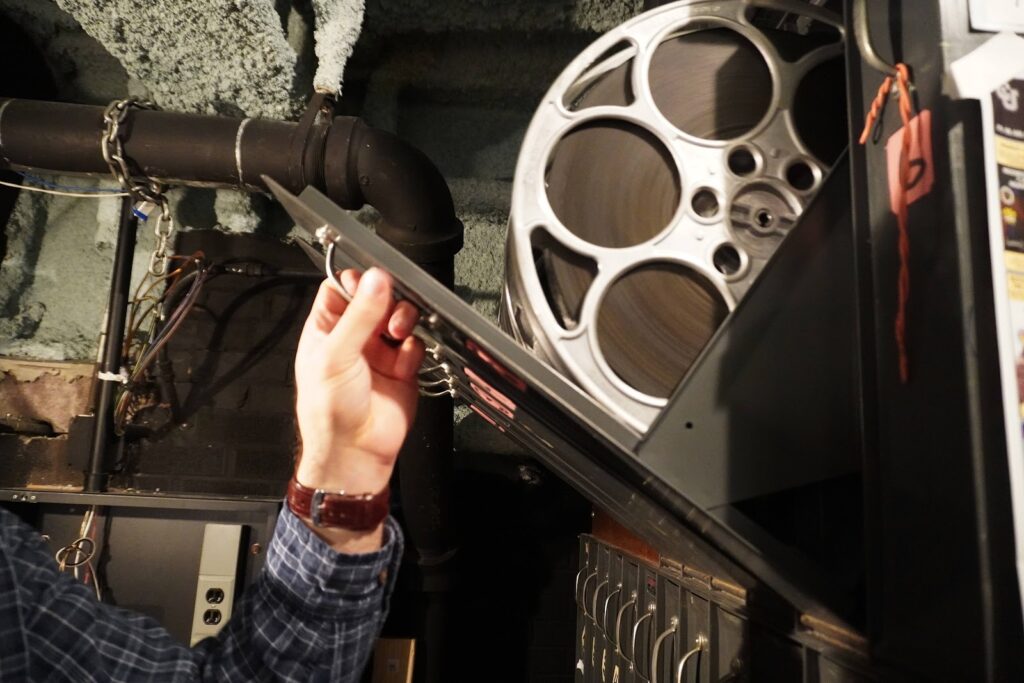
IFS Program Manager Jason Phelps retrieves a film reel from storage in Muenzinger Auditorium, on Dec 3, 2025. (Gavin Orth/Radio 1190)
“Anybody who it matters to, what the image looks like, 35mm is going to make a huge difference,” surmises Jason Phelps, the program manager of IFS, as he weighs a large steel film canister containing John Ford’s 1962 classic “The Man Who Shot Liberty Valence” in his hands. Phelps’ office, nestled in a third-floor corner of CU’s ATLAS building, is covered in film memorabilia, a large portion given to him by visiting filmmakers that have headlined screenings through the program’s history. More reels of “Liberty Valance” lie at his feet, and an autographed poster of the 2021 film “Mad God” sits above his desk.
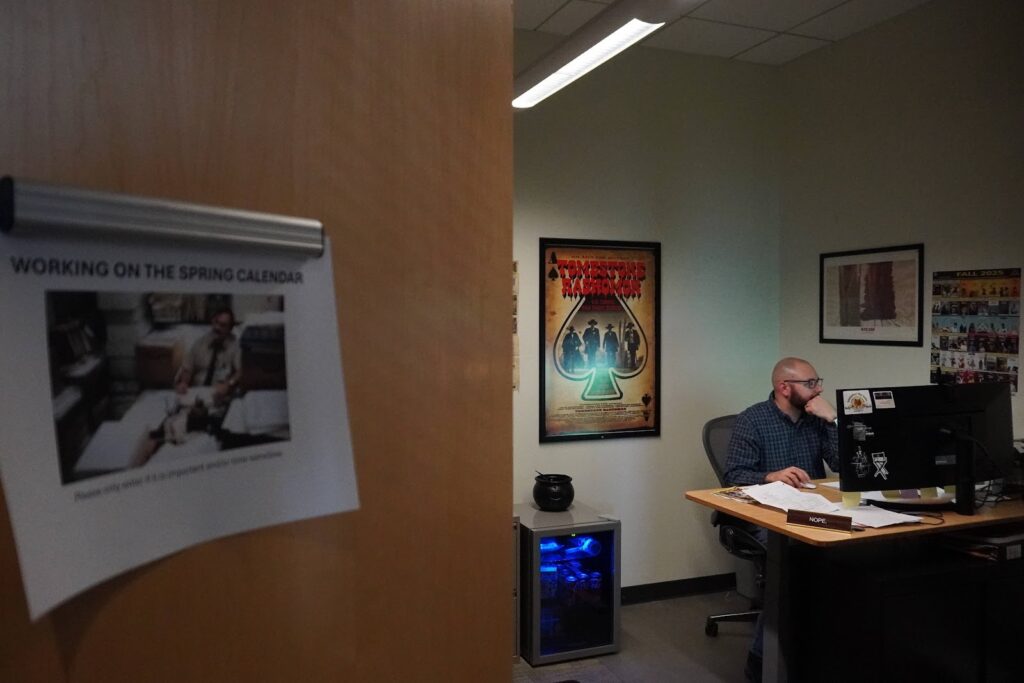
IFS Program Manager Jason Phelps works in his office in the ATLAS building at CU Boulder on Dec. 4, 2025. (Gavin Orth/Radio 1190)
Phelps comes across as an appreciator of film foremost as a physical medium; his experiences with films are personally enriched by the analog medium.
“A bad print can lessen it, sure, depending on the movie,” he remarks, acknowledging that the rarity of film prints in 2025 has led to some copies screened at IFS to be physically weathered or even damaged. “Tenenbaums” was one of these: the print had an unmistakable brownness that brought the entire film into a sepia-tone range. For Phelps, however, that sort of augmentation is almost an aesthetic boost: “It fits, right?”
To the average attendee, the projection capabilities at IFS are the series’ trademark, the advantage that sets screenings on Boulder’s campus apart. Phelps’ own arrival to the program coincided with a large-scale industry transition toward digital screenings. In an early move to boost CU’s screening capabilities, He had negotiated the acquisition of unused projection equipment from local AMC theaters, which had fully abandoned analog.
“I coordinated with corporate on the AMC side and said, ‘Hey, look. I know you got three or four theaters in the area that have projectors just sitting there. Would you want to donate some?”
When Phelps checks the equipment in the projection booth later that night, the AMC logos are still visible on the sides of the hulking 35mm projectors. The booth is fittingly claustrophobic, but glimmers with a cinephilic life force embellished by layers of student paraphernalia strewn across its length.
There are posters and newspaper clippings dating decades back, side by side with contemporary contact sheets and manuals scribbled with notes. Fascinatingly, the booth even has its own bathroom, which sits on the far end and is painted entirely cherry-red. The two massive AMC projectors which take up most of the room in the booth are designed to be changed mid-film, allowing a projectionist to swap from one reel to the other in the middle of a screening. IFS’ projectionists are a specially trained student force, operating in and out of classrooms in the daytime and in the projection booth at night.
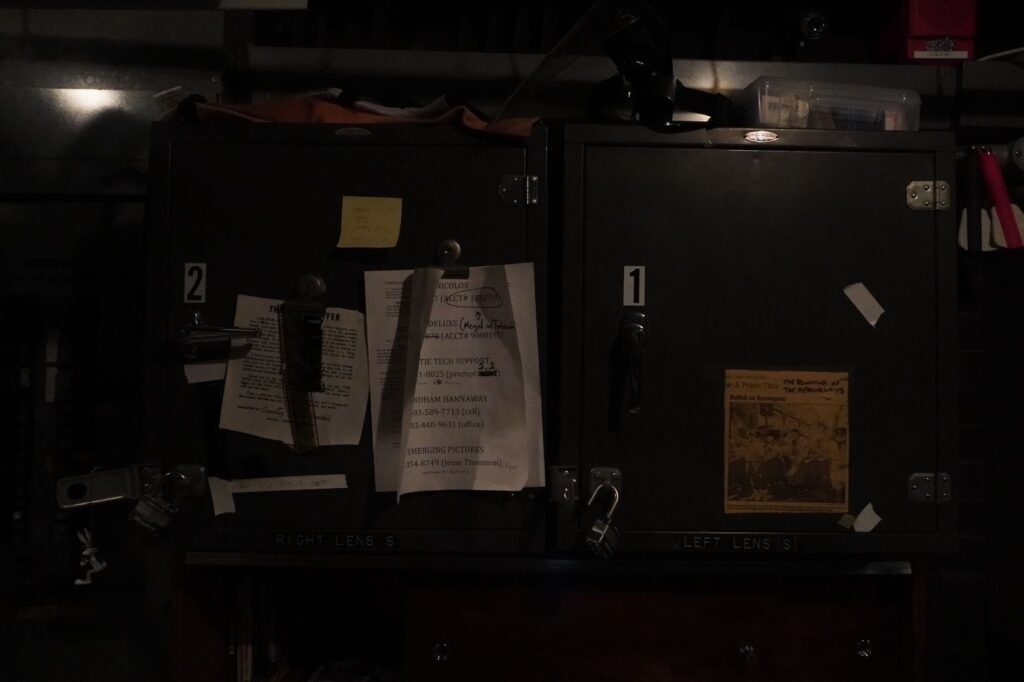
A set of lockers in Muenzinger’s projection booth after a screening on Nov. 19, 2025. (Gavin Orth/Radio 1190)
“This was a big thing for Sundance,” Phelps says, looking out over Muenzinger. “Seeing we had 35mm in that room, it was just like, ‘Oh, yeah, we might actually play stuff.’”
Phelps is referring to the relatively recent news that the Sundance Film Festival is moving to Boulder, CO; among various other venues in the city, several of the festival’s screenings will be held in Muenzinger Auditorium. To aid in this process, Muenzinger will be reoutfitted with a new sound system to accommodate for festival-level quality. The process has been compared by some in the film school, favorably or not, as an arts version of the changes Deion Sanders brought to CU’s athletic program; at the very least, the film department will have the attention of the school’s administration.
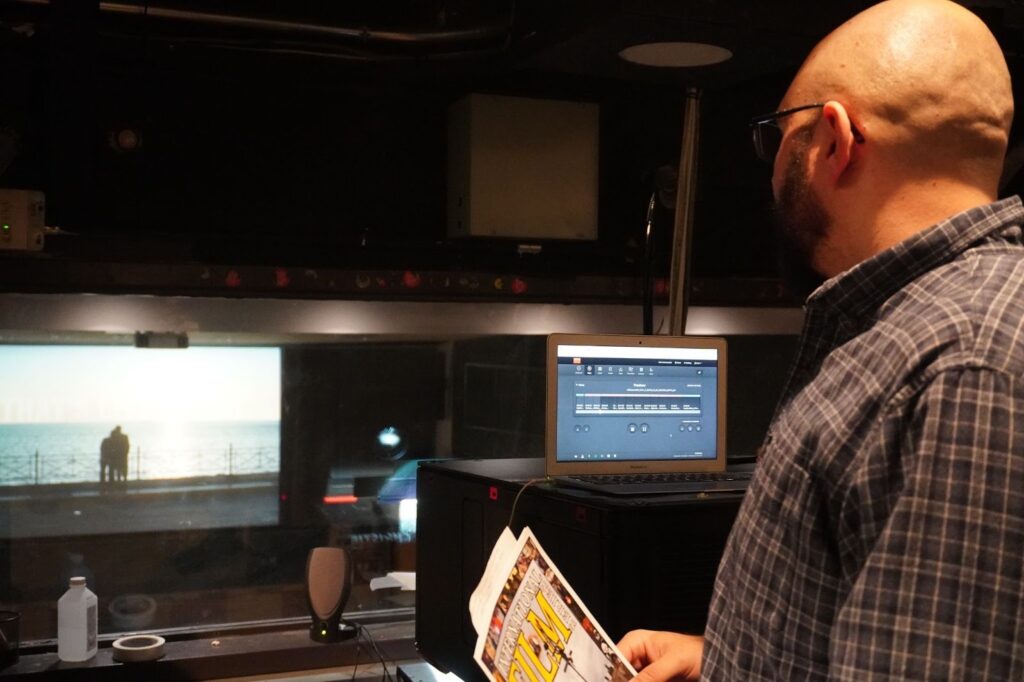
Jason Phelps looks out from Muenzinger’s projection booth on Dec. 4, 2025. (Gavin Orth/Radio 1190)
From the projection booth, the pre-show reel of titles coming next semester is visible. Phelps usually coordinates the approaching semester’s schedule over the course of the current one, but Spring 2025 is different: it boasts almost twenty visiting filmmakers from across the discipline, some of whom have not confirmed their presences yet. Phelps’ days are now split between coordinating the future and ensuring that nightly screenings go smoothly. Scanning the screen, he catches a mistake in the scheduling of a film.
“Is that supposed to be a Tuesday? Or a Friday?”
Phelps quickly whips out his phone and cross-references his calendar. The screening, a showing of Paul Thomas Anderson’s “One Battle After Another,” has the potential to be one of the larger draws of the Spring semester – especially because he’s managed to plan a guest appearance from the film’s editor, Andy Jurgensen. If the wrong date was put out on the print schedule, the entire talk could be jeopardized. From this screening on Dec. 3, it’s less than a week until the print schedule needs to be finalized — and every film needs to be triple checked for availability, especially when screening in analog.
Even without the eyes on IFS from Sundance, filmmakers seem to orbit around the program regularly. The Fall 2025 itinerary of IFS began with a screening of Spike Lee’s “Highest 2 Lowest” that preceded the film’s wide release date and featured a post-show panel with both the film’s screenwriter and the president of one of its featured production companies. Later on in the semester, IFS showed Steven Spielberg’s “War of The Worlds,” and hosted Bill Eyler, a lead VFX artist on the film who returned to CU recently to earn an additional degree. Because of Eyler’s time at the university, there was a strong sense of comfort in Muenzinger as he answered students’ questions.
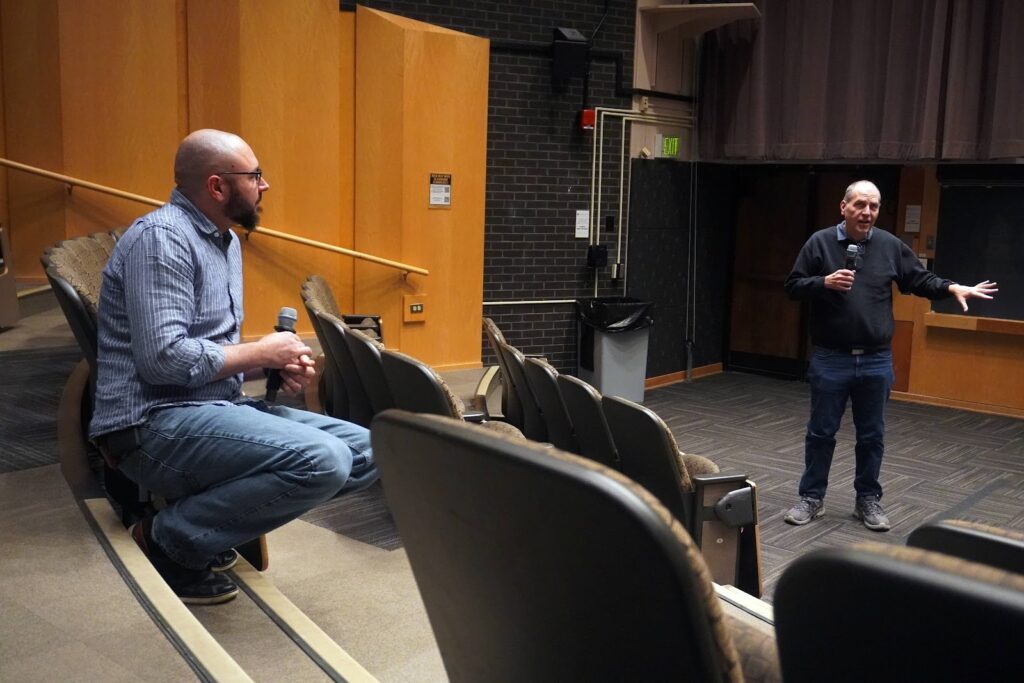
Jason Phelps (left) moderates a panel with VFX artist Bill Eyler in Muenzinger Auditorium on Nov. 19, 2025. (Gavin Orth/Radio 1190)