By William Flockton
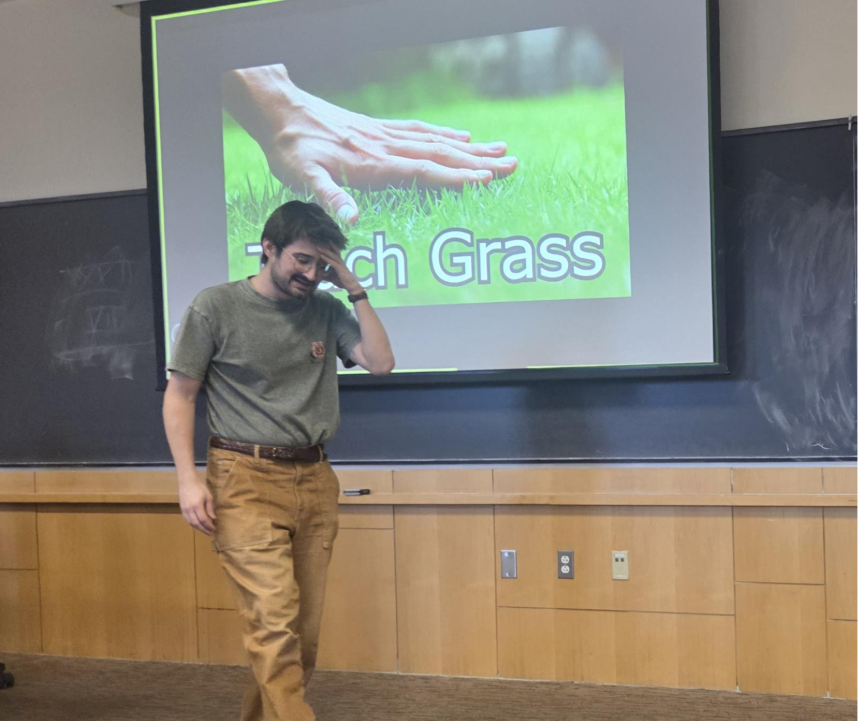
Adam Aleksic, a linguist and educational influencer. Undergraduate Distinguished Speaker lecture, Boulder, Co., Wednesday, Feb. 25, 2026. Aleksic stressed the importance of spending time in the real world as internet usage continues to create uncertainty about what is real. (Radio 1190/William Flockton)
How did Harvard graduate, linguist and influencer Adam Aleksic wait in the moments before his lecture at the University of Colorado Boulder? He didn’t look back at his slides, and he didn’t scroll on his phone. Instead, he asked the names of the college students who trickled into Eaton Humanities classroom 135.
“Oh, my grandmother’s name is Clara,” Aleksic said. “But her name is spelled with a K, so it sounds like Klara.”
With each name, Aleksic found a fact he could say about it. It was unfortunate that a student named Andrew shared his name with Prince Andrew and Andrew Tate. Oh, there’s a William, a few prince-names in the room today.
“My high school English teacher had a huge crush on him,” said a student in the back.
Aleksic is best known for his short-form videos on social media where he posts under the internet handle, Etymology Nerd. The influencer uses his content to explore the linguistics of modern slang like unalive and lowkey, and to discuss how social media and the internet change the way people speak.
He was invited to be the linguistic department’s undergraduate distinguished speaker at CU Boulder, where he would give a guest lecture on Feb. 25.
Students packed into the classroom for Aleksic’s lecture as the clock’s hands moved closer to 4 p.m.. Seats became fewer and fewer by number, and 10 minutes before the lecture started, students sat on the floor with their backs against the wall.
“Just hearing his perspective on things from a non-60-second video, I think was really nice,” said Zachary Frisch, a CU Boulder linguistics major.
Linguistics has been Frisch’s long-time interest. The student has followed Aleksic’s content on Instagram and TikTok and read the influencer’s book “AlgoSpeak.” Frisch also helped to set up and advertise for the event.
“So, I’m technically here on work, but it’s also something I would have definitely gone to,” said Frisch.
Each year, the CU Linguistics Club and the Undergraduate Linguistics Association invite a speaker to present at the linguistic department’s Undergraduate Distinguished Speaker event, with Aleksic being this year’s speaker.
“I’ve heard a lot of people be like, wow, you guys got him,” said Riley Carrol, an officer at the linguistics club who helped to organize the event. “In the past, our distinguished guest speakers have been more like hyper-niche linguistics people. Whereas when I say Etymology Nerd or show someone the flyer a lot of people, even if they don’t know anything about linguistics, have seen him on Instagram or on TikTok.”
The speaker for the event is chosen by a community vote. Members of the linguistic club nominate speakers, and a Google form is sent out to the club members and linguistics undergraduates to vote.
According to Carrol, about 25 people voted on the undergraduate distinguished speaker for this year. Aleksic won that vote by 60%, and the other candidates each received about 10% of the vote.
“The good part is when we talked to people, no one was like, ‘I don’t know who that is,’” said Saanika Fadia, another linguistics club officer.
Aleksic’s content has received an internet following of more than 3 million across TikTok, Instagram and YouTube. His videos have even attracted the attention of people who know little about linguistics or etymology, according to Carrol and Fadia.
Carrol credits Aleksic’s medium of short-form content as an important part of his popularity.
“Most people are a lot more willing to listen to a 30 second video than to like, watch a documentary on something,” said Carrol.
Though Aleksic points out that short form does have its flaws. A time limit of one-minute restricts how much information he can convey, and some nuance and ambiguity are lost as a result. Sensationalism can creep into the content as Aleksic finds himself being forced to say certain phrases to ensure his videos will be seen.
“I’m forced to say this is the most interesting something in order for my video to go viral,” Aleksic said.
Yet these same constraints allow him to make it easier to help people understand linguistics, and their relationship to the modern world.
“Everybody should have access to knowledge and understand this stuff,” said Aleksic. “I try to use my videos in a way where it opens the door. It’s like a foot in the door that gets people interested in linguistics.”
Aleksic hopes that his content will encourage his viewers to learn more about etymology themselves. Better yet, to grapple and struggle to learn the topic, as Aleksic believes it is a necessary process to learn.
“He’s very good at focusing on topics that people are already interested in,” Fadia said. “Like you might not watch just like general etymology content, but you might want to know like what’s the origin of brain rock themes or like what’s the origin of this word that you use all the time.”
Yet Aleksic’s focus on such topics have caused him some issues. He told a New York Times reporter he wished to be taken more seriously, even if his content revolves around words some people might find ridiculous or embarrassing.
“Language is power,” Aleksic said. “Who gets to use it as an active identity. You choosing to use a word is signaling something about your personality.”
Aleksic cites how slang tends to originate from marginalized and fringe groups, who invent words to reinforce their own identities. When their slang enters the mainstream, the words can convey the group’s culture or act as a form of cultural appropriation.
Various insights can be gleaned about culture from the slang people use, according to Aleksic. For example, the usage of words like unalive in social media represent the increased censorship in those spaces around death, and how people need to find a way around this censorship to talk about the topic.
The existence of technologies like Google trends has made it easier to track the changes and usages of modern words, according to Aleksic.
“We should be talking about the present to understand where we are right now, what’s going on in this moment,” said Aleksic.