
Many students complain that the planned changes would harm working conditions
By Nicholas Merl
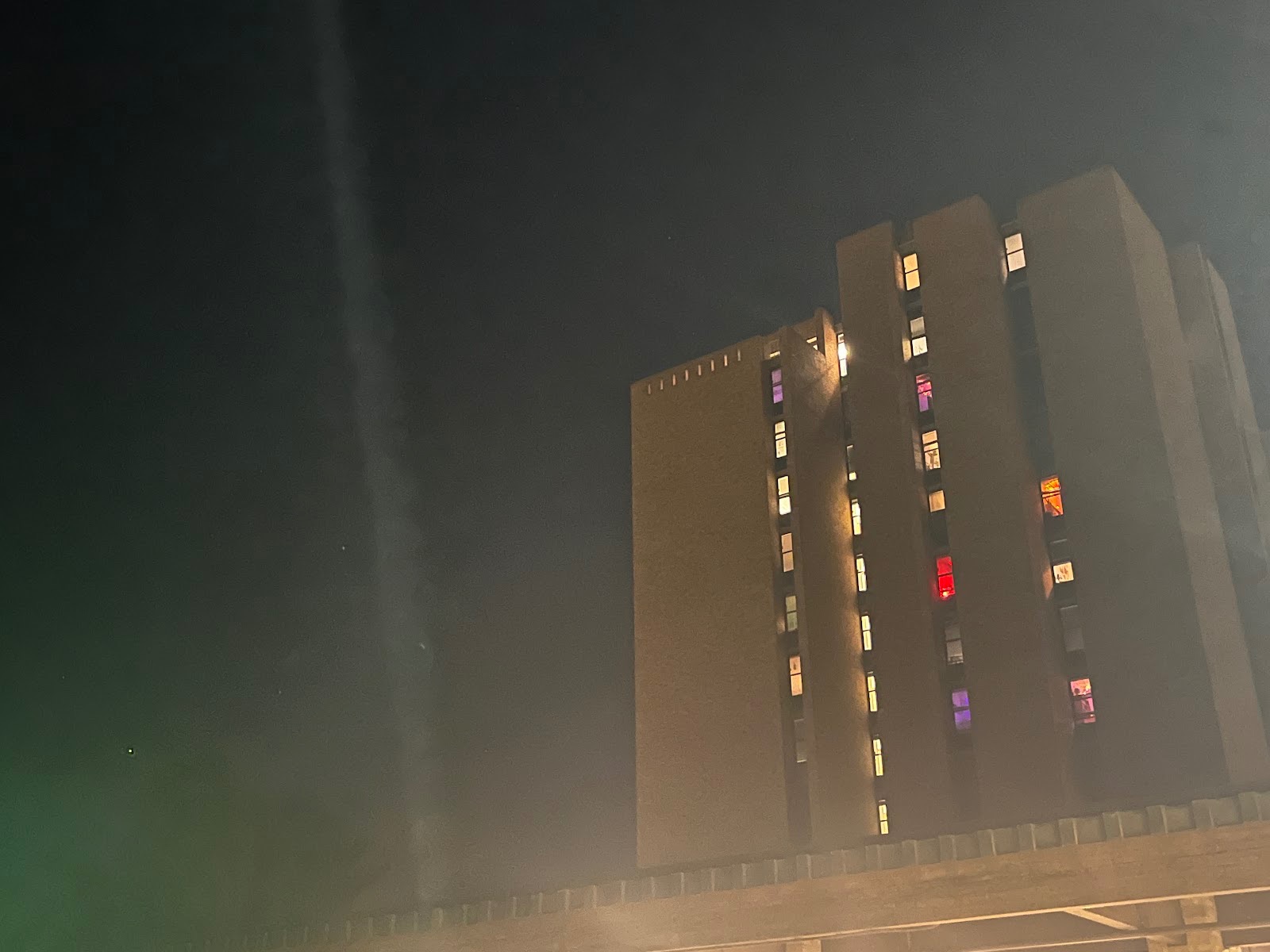
Stearns East Hall (Nicholas Merl/Radio 1190)
Editor’s Note: The real names and identities of several RAs interviewed for this piece have been omitted to protect their privacy.
In September of 2025, the University of Colorado Boulder’s Residence Life Department announced that it was replacing the Resident Assistant (RA) position with two new roles for students managing the dorms. These details were communicated to current RAs in a presentation on Sept. 17, as part of the Department’s so-called “Vision 2026.”
Up until now, RAs have been responsible for organizing events, one-on-one meetings with students called BuffChats and periodically patrolling dorms to make sure rules are followed. The last responsibility often requires RAs to be on-call late into the night.
Vision 2026 divides the RA role into “Community Engagement Mentors” and “Residential Support Coordinators.” While the engagement mentors are set to manage event planning and BuffChats, support coordinators will be responsible for doing rounds and being on-call. While Residence Life officials argued that the changes would reduce burnout among student leaders, many aspects of the plan were poorly received by current RAs.
One of the most disliked changes was a nearly 80% pay decrease for the new positions. Under the current system, regular RAs receive two forms of “pay:” coverage of room and board costs and a $115 stipend every two weeks. While the value of room and board coverage is considerable–worth $8,282 per semester according to CU Residence Life–the size of the stipend leaves students with very little actual money. With the school expecting RAs to dedicate roughly 20 hours a week to the role, the biweekly payment equals slightly less than $3 per hour worked.
But under the new system, the biweekly stipend for residential Support Coordinators and Engagement Mentors has been reduced to $25. Meanwhile, several RAs present at the September meeting claimed that Residence Life Officials said the workload would remain similar. According to multiple sources, school officials told students that this small amount was only kept to allow students to buy toothpaste and deodorant.
”How much toothpaste and deodorant could you buy at $25 every two weeks?” An anonymous RA present at the meeting, who will be referred to as Tyler, said, “[University officials are] out of touch.”
Part of the issue is that RAs are not student employees in the traditional sense. Instead, they are classified as “Student Leaders.” The aforementioned stipend plus room and board coverage technically aren’t seen as “wages” for a job. Rather, the school views them like a scholarship being awarded to volunteers. This way, much of the compensation awarded is tax-exempt.
But while this technicality allows the school to save money, it complicates things for RAs trying to access scholarships and aid. This is partly because the biweekly stipend is officially recorded as a lump sum equal to the full value that would be received across a semester. In effect, student leaders end up looking like they’ve been given money they don’t have yet, which makes it harder for them to apply to many need-based scholarships. Now with the stipend reduced but not eliminated, students will still be at a disadvantage on top of losing most of their cash income.
Another anonymous RA present at the September meeting, who will be referred to as Jane, says she already struggles to support herself as is. “I was literally on the phone with my mom this morning crying,” Jane said several weeks after the meeting. “I cannot manage a job, internship, RA and another part-time job.”
In Boulder, cost of living is over 40% higher than the national average. Many student leaders have a hard time making ends meet even with room and board covered. RAs often have one or more jobs outside of their residential role. But in a town where the average rent is over $1,800, they often lack any better alternatives.
”Most RAs I know have a second job. I have a second job. I have four jobs,” Tyler said. “ The unspoken thing they hold over our heads is that Boulder being Boulder–it’s so expensive to live here. They have a record breaking number of people who sign up to be an RA every year. The waitlist to be an RA is so long because people do not have the money to live here.”
Director of Residence Life Craig Kuehnert justified the pay cut with the school’s plan to take resident student leaders off of required front desk duty as part of Vision 2026. Currently, RAs are required to work at least four hours a week at their hall’s front desk. Next school year, this is set to be delegated to dedicated student employees.
“Because there is a downshift in that level of responsibility, the total valuation of the stipend has been adjusted,” Kuehnert said.
But many students feel that this change isn’t in their interest.
“Technically the only reason that we get paid with stipend is for working the desk,” a third RA, who will be referred to as Franz, said. “Since they’ve removed that, they’ve been able to justify not paying us since that’s technically what we’re getting paid for.”
Additionally, many of the RAs interviewed felt that the supposed decrease in workload was used as a rhetorical cudgel.
“They kind of just made us feel like we’re being greedy because they were like, well, this is less work, so why do you want to get paid?” Franz said.
But the stipend cut was far from the only aspect of Vision 2026 that RAs criticized. Other unpopular changes that those interviewed talked about included the addition of new responsibilities for the new residential roles, including potentially having to cover multiple buildings. Additionally, Student Leaders may increasingly have to share rooms with other students.
“A lot of people were worried about if we had a roommate with other RAs,” Tyler said. “They said that should not happen, but it is always a possibility.”
According to Kuehnert, Residence Life has always tried to keep Student Leaders in single rooms, but has occasionally had to compromise when faced with rising student numbers.
“In our current model, there’s a handful of RAs that share a space based on the type of room that they’re in. Most notably, for example, Bear Creek apartments are full apartments,” Kuehnert said. “So there are RAs that share spaces now. And there will continue to be, but the plan is that as best as we can, we maintain singles for the RAs.“
But despite the school’s attempts to win its student leaders over, most of those interviewed appeared unconvinced. Some RAs went so far as to claim that the school was essentially pressuring them into accepting the plan.
“We’re all not in a position where we really can do anything or else they’ll just fire us and pull one of the preferred alternates out of the Stearns basement and we’ll be gone within the week,“ Franz said.
This sentiment was widespread among interviewees who had witnessed the September meeting.
“It gave the vibe of a thinly veiled threat,” one anonymous student leader, who will be referred to as Wolfgang, said. “The fact that they gave us two to three weeks to react to an entire restructuring of the whole department and a massive pay cut is insane.”
Many do depend on the housing accommodations to be able to live in Boulder at all. Several RAs said that this has contributed to a toxic and exploitative work culture.
Eileen Kennedy, a former RA at CU Boulder, said that one of the main issues was RAs often being thrown into difficult situations without enough support from management.
“There were situations that I would be in where I’d be like, I shouldn’t be handling this,” Kennedy said. “People that are in upper management of Res Life have never been an RA before, [they] have never done a round before.”
RAs are often called to deal with situations including serious medical emergencies late in the night and early morning hours, in many cases having to act as first responders. Kennedy said that in one instance she had to help a student suffering from a potentially life-threatening allergic reaction.
“It was like, okay, I need to go study for my biology test. I have school tomorrow. I have an 8 a.m.,” Kennedy said. “You’re going to see something really traumatic and then you need to go take your test.”
Many RAs suffer from high stress, burnout and frequent exposure to traumatic experiences. Yet this was also one of the key issues that Vision 2026 sought to address. According to Kuehnert, the plan’s foreseen changes to student leaders’ positions are actually designed to help decrease such pressure.
“We’ve decided to move away from this expert generalist model where we need to be everything for everyone in our purview,” Kuehnert said. ”It’s hard for a student leader who’s working 15, 20 hours a week to have to be responsible for planning social events, connecting with students one-on-one, and also be trained on how to use defibrillators and diagnose anaphylactic shock.”
According to Kuehnert, Vision 2026 was drafted with the input of many former and current RAs, though none were explicitly identified. Residence Life also created several working groups to collect data from students, although it is unclear whether participants in this process always knew that they were informing a broader plan.
“Every working group or task force structured the feedback process a little bit differently. So some of them may have used some formal methods, and some of them may have informally,” Kuehnert said. “It is possible that some of our student leaders were providing feedback about the plan, but didn’t necessarily have the formal framework that it said, this feedback is informing Vision 2026.”
Despite claiming to be informed by the feedback and concerns of students, the actual Vision 2026 rollout meeting in September didn’t give RAs much of a chance to give their own feedback freely according to several sources. According to RAs interviewed, in the Q&A session following the meeting, students were directed to file questions through an online form requiring them to fully identify themselves. Staff picked which questions were to be read and answered.
“It was plain to see that they were not wanting to open the floor to questions,” Wolfgang said. “They either dodged all of the questions or deflected it to another office on campus.”
Many doubted whether any aspect of the plan had been influenced by students at all.
“Even though they had told us over and over again that students were involved in the process and were giving them feedback to implement different changes, I have yet to have found a student that has actually worked with them or feedback that they actually cared for, “ Franz said. “It’s been leaving the RAs to feel very detached and not communicated with in any meaningful way.”
The perceived lack of transparency, coupled with the seemingly broad unpopularity of the proposed reforms have led many to feel gaslit by school officials. In particular, students were critical of the tone that Residence Life officials used during the meeting, characterizing it as condescending and inconsiderate.
“My main problem was that, at least for me, this was not a discussion. This was, ‘hey, you’re doing this,’” Tyler said. “It felt very out of touch. I personally, like, do not tell me how to feel about things. I don’t think my employer should be telling me how to react to certain things.”
But many RAs simply viewed the announcement with a mix of despair and resignation.
“We’re in a business, essentially,” Jane said. “They preach student first, student first, person first, person first, but it has never in my time at Res Life ever felt like that.”
Still, Kuehnert stressed that Residence Life was trying to help students as much as possible. Most importantly, Kuehnert stressed Residence Life’s intention to continue to equip students with valuable life skills.
“ It was important for us to be able to create a system that recognized and valued some of our student leaders that are committed to the department, have been here for a long time. And to be able to elevate their level of responsibility, “ Kuehnert said. “The RA position is built on this premise or this model that students are peers, they are mentors, they are student guides to the students within their residential spaces. As a result, they are gaining a solid educational experience around things like teamwork, group dynamic, de-escalating conflict that are tangential to the core curriculum that they’re obtaining in the classroom.“
Regardless of the controversy surrounding it, Vision 2026 is set to come into effect in the fall semester of this year. It remains to be seen how current and new RAs will cope as they are transferred into their new roles. Nevertheless, the plan’s unpopularity among many RAs will probably remain an unavoidable fact that Residence Life will have to grapple with in the future.
“ We don’t have a voice in the whole deal,” Tyler said. ”The people above us really don’t care because their job isn’t us. They work for the university and for the residents. They don’t care about us.”